FM Sitharaman's Historic LTCG & STT Tax Remarks Spark Massive Stock Market Rally
13 hours ago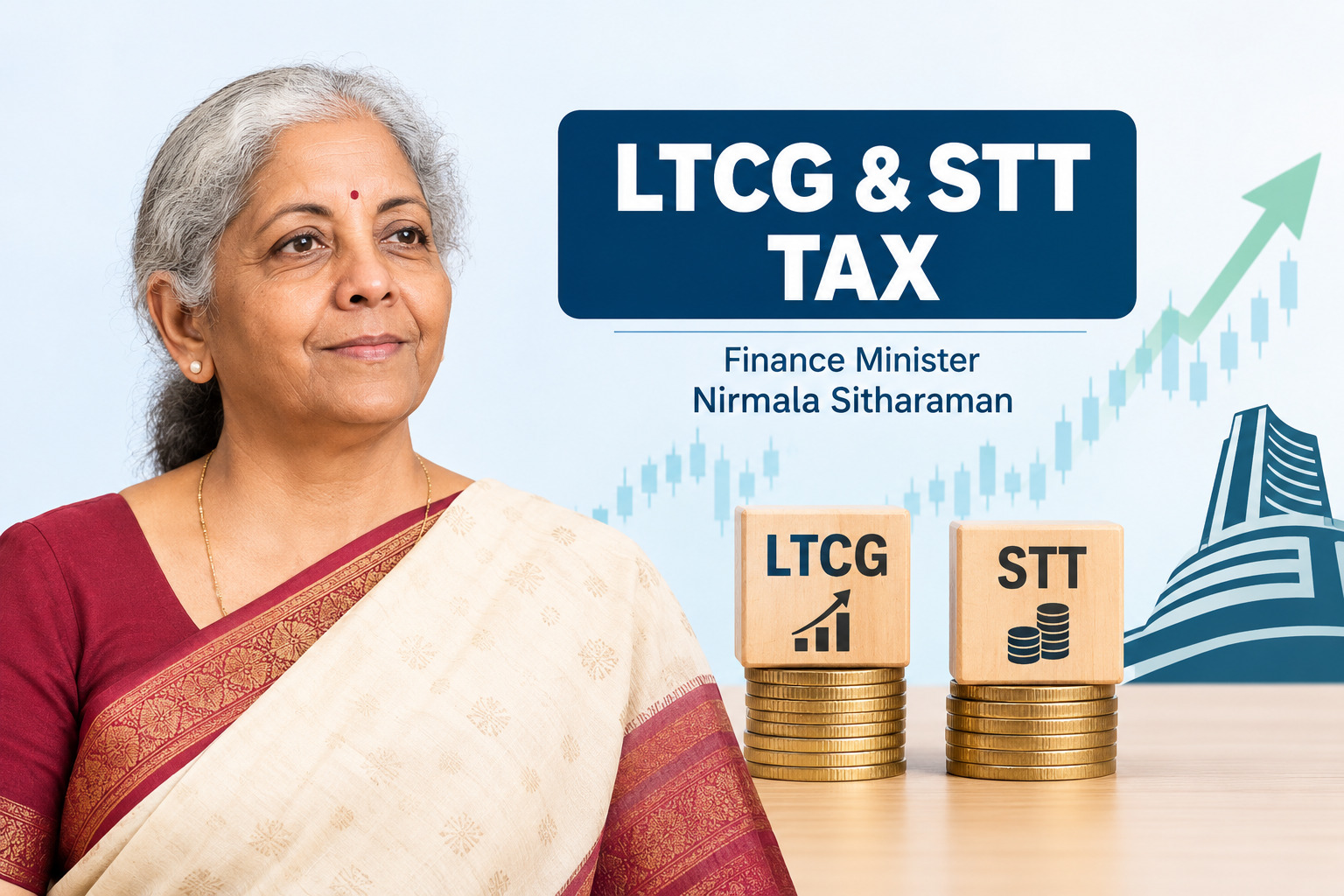
Indian stock markets staged a powerful recovery on Tuesday, October 13, after Finance Minister Nirmala Sitharaman expressed interest in hearing stakeholders’ views on long-term capital gains (LTCG) taxation and securities transaction tax (STT). Her remarks at the Bloomberg New Economy Forum revived hopes of a possible review of market taxes, helping the Sensex jump 1,109 points and the Nifty gain nearly 359 points.
The LTCG & STT debate has gained fresh attention as investors look for relief amid sustained foreign portfolio investor (FPI) outflows, elevated crude oil prices and uncertainty across global markets. Although the Finance Minister did not announce any tax cuts, her comments offered a positive sentiment boost to investors and traders.
The BSE Sensex closed at approximately 73,034, rising 1.54%, while the NSE Nifty 50 finished at 22,722, gaining around 1.60%. Information technology stocks led the recovery, with the Nifty IT index recording a sharp rise following encouraging corporate earnings and renewed buying interest.
Speaking at the Bloomberg New Economy Forum in New Delhi, Finance Minister Nirmala Sitharaman acknowledged that investors in India and overseas had raised questions about capital gains taxation and transaction charges in the securities market.
She described the ongoing discussion around the securities transaction tax (STT) as healthy and expressed willingness to hear different viewpoints. The debate also includes whether different asset classes should be treated similarly for taxation purposes.
Her remarks have renewed interest in possible Government discussions on LTCG and STT, particularly ahead of the next Union Budget.
However, the Finance Minister stopped short of committing to any changes, noting that Budget preparations were already underway. Investors should therefore distinguish between a willingness to consider stakeholder views and an official announcement of tax relief.
The latest developments have placed LTCG & STT tax firmly back on the market's radar, with participants watching for further clarification on the government's approach to equity taxation.
The Indian stock market rally followed a combination of policy-related optimism, strong buying in IT shares and short-covering activity.
The Sensex gained 1,109 points to close at 73,034, while the Nifty advanced 359 points to settle at 22,722. The gains marked the strongest single-session performance for the benchmark indices in several months.
Investors interpreted Sitharaman's comments as an opportunity for the government to reconsider concerns about the cost of investing and trading in Indian markets. Expectations of a possible review of LTCG and STT, helped improve sentiment, although the rally was also supported by sector-specific developments.
Short-covering, in which traders buy back shares or derivatives positions previously sold short, can accelerate market movements when prices begin to rise. This activity may have contributed to the sharp recovery during the session.
Nevertheless, a single-day rally does not necessarily confirm a sustained market reversal. Traders should continue to monitor price action, trading volumes, support and resistance levels, and subsequent market developments.
To understand why the debate matters, investors need to know how the two taxes operate.
Long-term capital gains tax applies to eligible profits earned from selling an asset after holding it for the prescribed period.
For eligible listed equity shares and equity-oriented mutual funds covered by Section 112A, the current framework generally applies a 12.5% tax to qualifying long-term capital gains exceeding ₹1.25 lakh in a financial year, subject to applicable conditions.
Capital gains taxation affects the net returns investors receive after selling investments. Consequently, possible LTCG tax changes in India are closely watched by long-term investors, portfolio managers and foreign institutions.
A change in the applicable rate, exemption threshold or eligibility conditions could influence investment decisions. However, the impact would depend on the details of any eventual policy announcement.
The Securities Transaction Tax is levied on specified securities transactions at rates prescribed under the law. Unlike capital gains tax, which applies to taxable profits, STT is linked to eligible transactions.
This distinction is particularly important for active traders who execute multiple orders during a trading session. Transaction-related costs can affect net trading returns even when individual trades generate relatively small profits.
STT is also separate from brokerage, exchange transaction charges, applicable GST, stamp duty and other costs associated with buying or selling securities.
As a result, potential STT tax changes matter to equity investors and derivatives traders alike. Any future revision could alter transaction costs, depending on the instruments and transactions covered.
The debate around LTCG & STT reflects wider concerns about India's investment environment, foreign capital flows and the cost of participating in domestic markets.
Foreign portfolio investors have been net sellers of Indian equities amid concerns about global interest rates, currency movements, geopolitical uncertainty and relative market valuations. Investors also compare the costs and potential returns of investing in India with opportunities in other markets.
Some market participants argue that reviewing capital gains taxation and transaction levies could improve the attractiveness of Indian equities and encourage longer-term investment. Others emphasise the importance of maintaining a predictable tax framework and balancing investor interests with government revenue requirements.
Taxation is only one factor influencing investment decisions. Corporate earnings, economic growth, currency stability, valuations and global risk appetite also play significant roles in determining the direction of foreign and domestic investment flows.
For this reason, any future decision on LTCG & STT will be assessed alongside the broader economic and market environment.
Information technology shares were among the strongest performers during Tuesday's session, providing substantial support to the benchmark indices.
The Nifty IT index rose approximately 5.2%, marking its strongest performance in more than 17 months. HCL Technologies gained around 8.4% following its quarterly earnings announcement, while Tata Consultancy Services advanced approximately 6.8%.
The gains reflected renewed buying interest in technology stocks following company-specific developments and a broader shift in market positioning.
The IT sector's performance demonstrated that the rally was not driven exclusively by expectations surrounding LTCG & STT. Corporate earnings, sectoral momentum and global technology- market movements also influenced investor sentiment.
For stock market participants, this highlights the importance of tracking earnings announcements, sector performance, trading volumes and price trends when assessing potential market opportunities.
However, sharp price increases do not guarantee continued upside. Investors and traders should consider valuations, business fundamentals and risk exposure before making decisions.
Alongside the tax debate, Sitharaman addressed concerns about the Indian rupee's depreciation against the US dollar.
She indicated that the Reserve Bank of India would continue taking steps to curb excessive currency volatility rather than targeting a specific exchange-rate level. She also attributed much of the rupee's recent weakness to external economic pressures.
Currency movements can affect Indian markets in several ways. A weaker rupee may increase the cost of imported commodities, including crude oil, potentially putting pressure on inflation and corporate expenses. Export-oriented businesses may benefit from certain currency movements, while companies reliant on imported inputs can face higher costs.
Foreign investors also consider exchange-rate movements when calculating returns in their home currencies.
Consequently, developments around LTCG & STT tax are only one part of the market outlook. Currency trends, crude oil prices, inflation, interest rates and global economic conditions remain important variables for investors to monitor.
The latest market recovery has brought renewed attention to intraday trading opportunities, but traders should avoid making decisions based solely on tax-related headlines.
Several factors deserve close monitoring:
1. Nifty and Bank Nifty price action: Traders can monitor support and resistance levels, opening-range breakouts and changes in trading volume to understand short-term market momentum.
2. Short-covering and market breadth: A rally driven partly by short-covering can be sharp, but traders should assess whether buying interest continues across sectors and stocks.
3. Sectoral momentum: IT stocks led Tuesday's recovery. Monitoring sector indices and stock-specific catalysts can help traders distinguish broad market strength from isolated gains.
4. Volatility and risk management: Intraday traders should consider position sizing, stop-loss orders, liquidity and transaction costs. A rapid market reversal can turn an apparent opportunity into a loss.
5. Policy announcements: Any official clarification concerning LTCG & STT tax could influence market sentiment. Until a formal decision is announced, traders should treat expectations of tax relief as uncertain.
Market participants following intraday trading strategies should also account for brokerage, STT and other applicable charges when calculating net profits. Frequent trading can increase these costs, making disciplined execution and risk management particularly important.
The sharp rise in Indian equities on October 13 reflected renewed investor optimism after Finance Minister Nirmala Sitharaman welcomed further discussion on market taxation. The Sensex gained 1,109 points, the Nifty advanced nearly 359 points, and IT stocks provided significant support to the recovery.
The debate over LTCG & STT highlights continuing concerns about transaction costs, investor returns and India's competitiveness as an investment destination.
However, no official tax reduction has been announced. The outcome will depend on future government decisions and formal policy announcements.
For investors and traders, the key is to separate market expectations from confirmed developments. Monitoring corporate earnings, economic indicators, currency movements and market trends can provide a more balanced perspective as Indian equities respond to evolving policy discussions.