How US Midterm Results Signal Breakthrough Growth for Dalal Street
48 minutes ago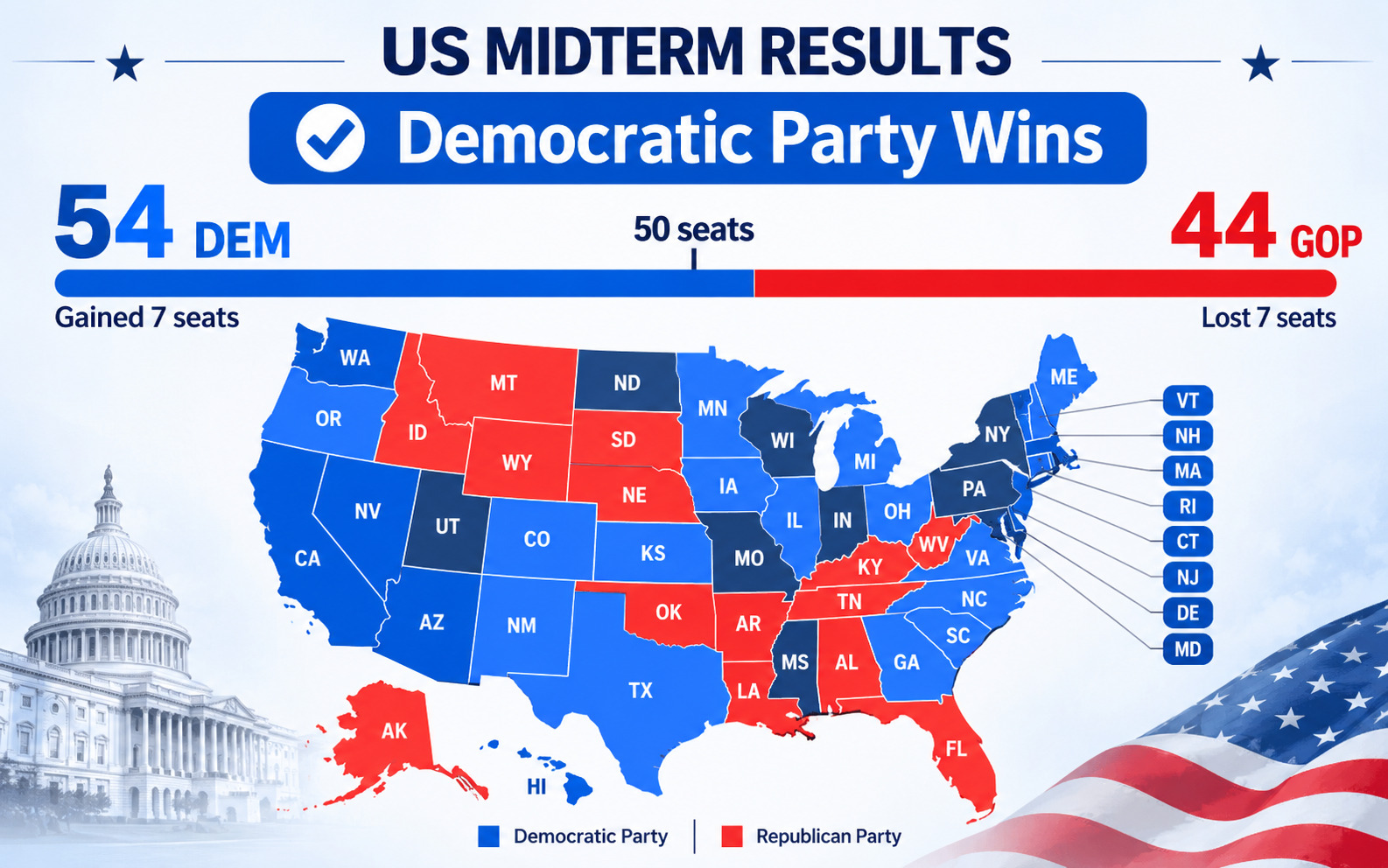
The financial world is closely analyzing a shifting political landscape in Washington as counting progresses following the election. Global equity markets, foreign exchange desks, and commodity exchanges reacted swiftly as investors evaluated how the US midterm results would alter trade policy, fiscal spending, and monetary trajectories worldwide. From Wall Street to Mumbai’s Dalal Street, market participants are actively recalibrating their portfolios in response to these pivotal legislative outcomes.
Across Indian financial markets, the immediate reaction to the US midterm results was marked by early gains and cautious optimism. Benchmark equity indices, including the BSE Sensex and NSE Nifty 50, posted positive momentum as early voting trends indicated potential Democratic gains in Congress. The BSE Sensex jumped over 280 points in early trading sessions as investors assessed the broader macroeconomic implications. For emerging economies like India, the primary implications of the US midterm results involve potential legislative checks on unilateral trade tariffs, moderating US Treasury yields, andn fluctuatios in global crude oil prices.
The core driver behind recent market movements is the evolving balance of legislative power in the United States. Early election returns from the US midterm results pointed to significant Democratic momentum, including key Senate victories in North Carolina by Roy Cooper and in Georgia by Jon Ossoff. Ahead of the voting, Emkay Research had assigned a 60% probability to Democrats securing control of both houses of Congress and a 30% probability to a divided legislature.
Congressional Outcome Scenario Estimated Probability Anticipated Market & Policy Impact Democratic Sweep (House & Senate) 60%Stronger checks on presidential power, lower US dollar, moderating bond yields, and heightened regulatory scrutiny.Divided Congress (Dems House / Reps Senate) 30%Legislative gridlock, potential budget disputes/shutdown risks, but unchanged executive tariff powers.Unified Republican Control 10%Continuation of existing trade, tax, and immigration policy trajectories.
Market strategists note that an unfavorable outcome in the US midterm results could leave President Donald Trump operating in a 'lame duck' capacity during the final two years of his term. While the president retains significant executive authority over foreign policy and statutory trade provisions-such as Section 232 and Section 301 tariffs-a Democratic congressional majority introduces rigorous legislative oversight and budgetary checks. However, trade think tanks like the Global Trade Research Initiative (GTRI) emphasize that both major US political parties increasingly support economic nationalism, domestic manufacturing protections, and supply chain security.
The initial market response to the US midterm results was clearly reflected across global currency pairs and benchmark sovereign bond yields. The US Dollar Index softened toward 101.37, while 10-Year US Treasury yields moderated down near 4.90% to 4.95% after approaching multi-month highs.
This easing of the US greenback provided immediate support for emerging market currencies. The Indian Rupee (USD/INR) gained ground to trade near 94.75. A weaker US dollar generally encourages foreign institutional investor (FII) flows into emerging market equities and helps lower imported inflation costs for energy-importing nations.
In commodities and digital assets, price action remained attentive to the US midterm results. International spot gold prices consolidated near $3,935 per ounce as a weaker dollar lent support to non-yielding bullion. Meanwhile, Bitcoin traded near $76,800 to $77,500, with crypto market participants weighing the prospect of tighter regulatory oversight under a Democratic-influenced legislative agenda.
For Indian equity benchmarks, the US midterm results arrived during a period marked by elevated crude oil volatility, corporate earnings pressures, and recent foreign capital outflows. Prior to the election, the Sensex and Nifty 50 had experienced declines of up to 12% in 2026.
Historical market data offers encouraging context for domestic investors. An analysis of the seven US midterm election cycles since 1998 shows that the Nifty 50 recorded positive returns in five instances across one-month, three-month, and six-month periods following the polls.
In sector-specific movements, the Nifty 50 surged 1.58% (370 points) to 23,811 on the day preceding the final counts, driven by gains in FMCG (+3.65%), realty, and banking stocks. Analysts highlight that if the US midterm results lead to increased regulatory oversight or margin pressures on Wall Street technology giants, global institutional capital could rotate toward Indian equities as a favored 'counter-AI' allocation trade.
A key focal point for economists analyzing the US midterm results is the future of trade negotiations between Washington and New Delhi. Prior to the midterms, the two nations had been negotiating an interim trade agreement under a framework established in early February 2026.
Under this negotiated framework, India agreed to reduce or eliminate duties on US industrial and agricultural goods, purchase over $500 billion worth of American energy, technology, and coal over five years, and align on digital trade rules. In turn, Washington agreed to lower reciprocal tariff rates from 25% to 18% and remove an additional 25% penalty tariff linked to Russian crude oil purchases.
Trade experts observe that while the US midterm results may curtail sweeping legislative tariff changes, President Trump retains executive powers under Section 232 and Section 301. Facing a split Congress, the US administration may seek to finalize pending bilateral agreements to demonstrate diplomatic progress. However, policy analysts caution Indian negotiators against accepting asymmetrical terms merely for short-term tariff relief, advocating instead for enforceable reciprocity and long-term national interest.
Beyond political headlines, international energy prices and Middle East geopolitical developments remain pivotal variables for the Indian economy. WTI crude oil prices consolidated near $96.09 per barrel while Brent crude hovered near $104 per barrel amid ongoing peace negotiations and regional supply risks around the Strait of Hormuz.
For domestic equity markets, lower crude oil prices are a key fundamental tailwind, directly easing current account pressures, dampening inflation, and supporting corporate margins. Financial advisors emphasize that while the US midterm results clear immediate political uncertainty, long-term market trends will ultimately depend on core macroeconomic drivers-including domestic corporate earnings growth, foreign institutional investor (FII) flows, and central bank interest rate decisions.
In summary, the US midterm results mark a major milestone in global political economy, recalibrating congressional power dynamics in Washington. For Indian equities and the rupee, the election outcome offers temporary relief from trade policy uncertainty, contributing to a pullback in the dollar index and stabilizing domestic benchmark indices. As markets process the full impact of the US midterm results, investors are advised to remain focused on fundamental economic indicators while monitoring global energy trends and international trade developments