US Fed Reserve Keeps Interest Rates Unchanged at 3.75%-4% Amid Persistent Inflation
2 hours ago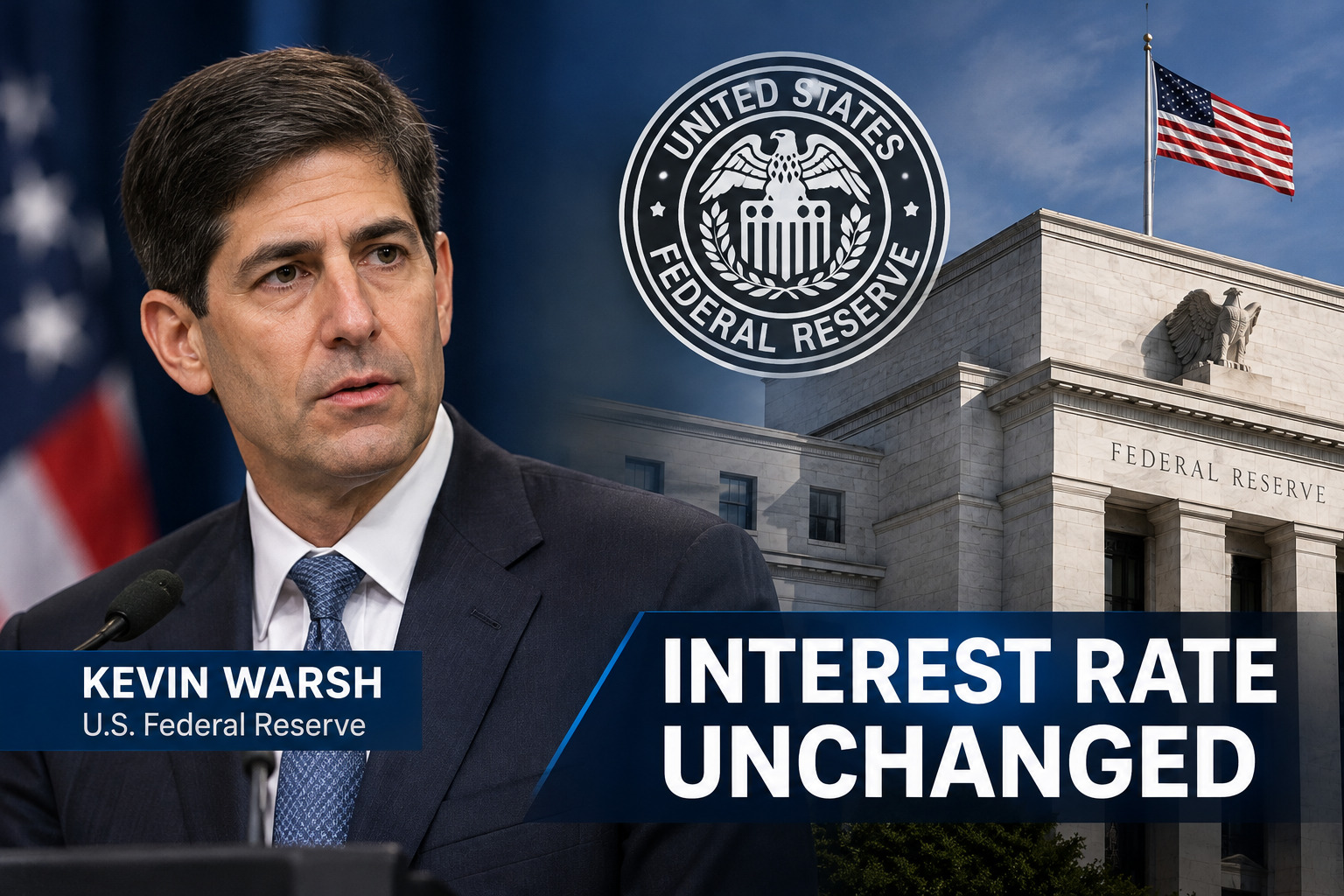
The US Fed Reserve has kept its benchmark interest rate unchanged at 3.75%-4.00%, choosing to wait for more economic data as inflation remains above its long-term target of 2%. The decision, announced after the Federal Open Market Committee (FOMC) meeting, was in line with market expectations but has left investors watching closely for clues about the central bank’s next move.
The decision comes at a time when rising living costs, geopolitical uncertainty and higher energy prices continue to put pressure on the US economy. While economic activity remains strong, persistent inflation has made it difficult for policymakers to determine whether interest rates should rise further or remain at current levels.
For investors and traders, the latest announcement is important because US interest rate decisions can influence global financial markets, currency movements, bond yields and investor sentiment, including in India.
The US Fed Reserve maintained its benchmark interest rate within the 3.75%-4.00% range, keeping monetary policy unchanged at its latest meeting. The decision was approved by a 10-2 vote, with Fed Governor Lisa D. Cook and Cleveland Fed President Beth M. Hammack voting in favour of a 0.25 percentage-point rate hike.
The two dissenting votes highlight the differences among policymakers over how to tackle inflation. While some officials believe additional tightening may be necessary, others appear willing to wait for further evidence before making another policy adjustment.
In its statement, the central bank emphasised that inflation remains elevated and that additional economic information would help determine the appropriate policy direction. Its long-term objective remains bringing inflation back to 2% without unnecessarily weakening economic activity.
The decision also leaves the possibility of another rate hike open, although officials have not provided a clear indication of what they will do at their next meeting.
The primary reason for holding rates steady was the need to assess the impact of existing monetary policy while gathering more information about inflation and economic growth.
Despite persistent price pressures, several indicators suggest that the US economy remains resilient. Consumer spending has held up, business investment continues to support activity, and productivity growth has remained strong. Employment conditions have also shown relative stability.
These factors make the policy decision more complicated. Raising rates could help control inflation by reducing borrowing and spending, but it could also increase financial pressure on households and businesses.
At the same time, leaving rates unchanged gives policymakers an opportunity to assess whether existing measures are sufficient to bring inflation down.
The US Fed Reserve is therefore balancing two priorities: maintaining price stability and supporting sustainable economic conditions. Acting too aggressively could slow growth, while delaying further action could allow inflation to remain elevated for longer.
Inflation continues to be one of the biggest challenges facing US policymakers.
Consumer prices rose 3.7% year-on-year in September, according to the figures provided in the latest economic update. This was significantly higher than the 2.4% inflation rate recorded in February, before the Iran war intensified concerns about energy supplies and prices.
Higher costs for fuel, groceries, clothing and other essential items have also affected consumer confidence. As everyday expenses increase, households have less flexibility in their budgets, creating concerns about affordability and the overall cost of living.
Energy prices are particularly important because rising oil prices can increase transportation and production costs. Businesses may pass these expenses on to consumers, adding further pressure on inflation.
For the US Fed Reserve, the challenge is to prevent these price increases from becoming persistent without putting unnecessary pressure on economic growth.
The central bank has reiterated its commitment to bringing inflation back to its 2% target. However, the timing and pace of any additional policy action remain uncertain.
Following the policy announcement, Fed Chair Kevin Warsh highlighted the strength of consumer spending and business investment. He acknowledged that economic activity had been stronger than expected, while stressing that inflation remained central to the committee's discussions.
Warsh reiterated the central bank's responsibility to restore price stability and indicated that policymakers would remain prepared to respond as economic conditions changed.
He did not provide a clear signal about whether interest rates would rise at the December meeting. Instead, he emphasised that future decisions would depend on incoming economic information and the circumstances at the time.
This means investors should not automatically assume that the current pause signals the end of the rate-hiking cycle.
The US Fed Reserve will continue to evaluate inflation, employment, consumer demand and broader economic developments before deciding whether another adjustment is necessary.
Warsh also rejected suggestions that political considerations influenced the decision. With the US midterm elections approaching and affordability remaining a major public concern, he stressed that politics played no role in the committee's deliberations.
The next interest rate decision remains uncertain. Although the central bank has kept rates unchanged for now, persistent inflation could lead policymakers to consider another increase if price pressures fail to ease.
Several factors could influence the next decision:
Inflation data: If consumer prices remain elevated, pressure for tighter monetary policy could increase.
Employment conditions: A stronger labour market may give policymakers more room to maintain restrictive rates, while signs of weakness could encourage caution.
Energy prices: Further increases in crude oil and fuel prices could add to inflationary pressure.
Consumer spending: Strong demand may support economic growth but could also make inflation more difficult to control.
Geopolitical developments: Global conflicts and supply disruptions could influence energy prices, trade and financial market sentiment.
The US Fed Reserve has not committed to a particular course of action for December. Investors will therefore be paying close attention to upcoming economic releases and statements from policymakers.
For stock market participants, uncertainty surrounding the next decision could contribute to fluctuations in share prices, bond yields and currency markets.
US interest rates play an important role in determining borrowing costs, investment flows and market valuations. As a result, even when the central bank leaves rates unchanged, its policy statement can influence trading activity across global markets.
When interest rates remain high, companies may face increased borrowing costs, which can affect expansion plans, earnings and valuations. Higher yields on government bonds can also make fixed-income investments more attractive relative to stocks.
On the other hand, stable interest rates can provide some certainty for businesses and investors, particularly when a rate hike was a possibility.
Technology and other growth-oriented stocks are often sensitive to interest rate expectations because their valuations depend heavily on anticipated future earnings. Financial stocks, meanwhile, may respond differently depending on lending activity, funding costs and interest margins.
In India, changes in US monetary policy can influence foreign institutional investor flows, the rupee's movement against the dollar and overall market sentiment. If US yields remain attractive, foreign investors may become more selective about allocating funds to emerging markets.
However, the impact on Indian stocks will also depend on domestic economic growth, corporate earnings, crude oil prices and the Reserve Bank of India's policy decisions.
Traders should therefore consider the broader economic picture rather than interpreting the Fed's decision in isolation.
With the next policy move still unclear, investors should monitor upcoming inflation figures, employment reports, energy prices and updates on global economic conditions.
These indicators may provide a clearer picture of whether inflation is easing or whether the central bank could need to tighten monetary policy further.
For short-term trading, unexpected economic data can trigger volatility in major indices, currencies and commodities. Investors should also pay attention to bond yields and movements in the US dollar, as both can provide clues about changing interest rate expectations.
Long-term investors, meanwhile, may benefit from focusing on company fundamentals, earnings growth and portfolio diversification instead of making decisions based solely on a single policy announcement.
The latest decision does not guarantee that interest rates will remain unchanged for the rest of the year. A change in inflation trends or economic conditions could alter the policy outlook.
The US Fed Reserve has chosen to maintain interest rates at 3.75%-4.00%, prioritising a cautious approach while inflation remains above its 2% target. Strong economic activity has reduced the immediate need to ease policy, but persistent price pressures mean another rate hike cannot be ruled out.
With no clear guidance on the December decision, markets will continue to respond to incoming economic data and statements from policymakers.
For investors and traders, the key takeaway is to stay alert to changes in inflation, energy prices, bond yields and global capital flows. These factors could shape market sentiment in the coming weeks and influence trading opportunities across both US and Indian financial markets.